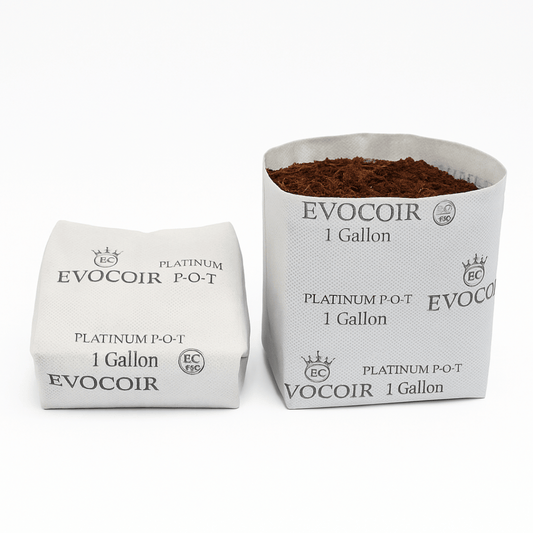
Easy to order great service great product equals very happy customer
Great quality and quick shipping. My second order.
Most growers spot light stress only after it’s already burning the tops — pale crowns, twisted leaves, foxtails, or bleaching. But the earliest warning sign doesn’t show on the plant at all. It shows on the leaf surface temperature, and an infrared thermometer reveals it instantly.
Grow rooms run on numbers: PAR, PPFD, DLI, RH, VPD. But one number often gets ignored — Leaf Surface Temperature (LST). This is the actual temperature of the leaf itself, not the surrounding air.
The difference matters because:
Air temperature can look perfect while your leaf surface is quietly running 3–6°F hotter than the rest of the room. By the time you see damage, the stress has already been happening for days.
An infrared (IR) thermometer is a simple tool: point it at a leaf, press the trigger, and you get a surface temperature reading in seconds. But for cannabis growers, it's a way to “scan” the canopy for invisible stress.
With an IR thermometer, you can:
Think of it as a grow-room ultrasound — quick, portable, and way more revealing than staring at the wall controller.
Many growers switching from HPS to LED struggle because LEDs create different thermal behavior:
This is why growers sometimes think “my temps are perfect” yet still see light stress. They’re reading the wrong temperature. An IR thermometer fixes that instantly.
There’s no universal magic number, but most growers use LST ranges as a guideline:
What matters most is consistency. If top colas are sitting at 86°F and lower branches are at 79°F, the canopy isn’t balanced. That unevenness creates mixed-quality buds within the same plant.
To get real readings, you need a consistent method. Most growers follow steps like these:
Leaf temps naturally rise as lights warm up, so pick a consistent window (e.g., 2 hours into lights-on).
This is where heat accumulation and bleaching happen first.
Check corners, edges, and a few mid-canopy leaves to map the spread.
Most IR guns have a defined distance-to-spot ratio. Too close or too far gives skewed readings.
Example:
This delta is often more telling than the raw temperature itself.
When you map leaf temps consistently, patterns pop out:
Instead of guessing intensity or height, you adjust based on real plant temperature — the only data point that matters to the leaves themselves.
Here’s how IR temp readings help you stay ahead:
Instead of reacting to bleaching after it's too late, you’re catching issues days earlier.
Most people only think about airflow and humidity during drying, but surface temperature matters just as much. If branches or racks get too warm, moisture moves faster than expected, leading to overdry outer layers.
IR thermometers help you:
The goal is predictable moisture movement from harvest to storage — and surface temperature is a major part of that equation.
An infrared thermometer costs less than a bottle of nutrients, but it gives you data that affects the entire crop. Light stress, foxtailing, bleaching, nutrient flow, VPD stability, dry room consistency — all of it is easier to manage when you know exactly how hot your leaves actually are.
Most growers make decisions based on what the room feels like. The pros make decisions based on what the plant feels like.
An IR thermometer bridges that gap.
No comments
0 comments